Wednesday, April 17, 2013

First home away from home for the Greeley Chorale: The Park Inn by Radisson Belfast


The Greeley Chorale travelers will be staying for the first three tour nights (Thursday May 30, Friday May 31 and Saturday June 1st, 2013) in Northern Ireland's charming and lively capital city Belfast, at the Park Inn by Radisson Belfast Hotel.

This stylish four star hotel is centrally located and has 145 rooms that include free wireless high-speed internet.
Each room features a flat-screen television. The bathrooms are furnished with complimentary toiletries, a hair dryer and a shower with sunflower head. There is an onsite fitness center with flat-screen TVs that includes a sauna and steam room. 
The hotel restaurant RBG Bar & Grill is open 24 hours and is famous for its delicious sizzling steaks served directly from the grill. Here you can take a look at their latest menu. 

The Park Inn by Radisson Belfast Hotel is centrally located and just a few minutes away from Belfast's must-sees such as Victoria Square and St. Anne's Cathedral.
There are also restaurants, bars and pubs close to the hotel as well as shopping malls.
A very convenient hotel service is the direct line to the preferred taxi company - Black Taxi Rank.
However with the Incantato Tour busses at your disposal you may not need a cab after all, especially since a lot of Belfast's sites are also within walking distance.




Tuesday, April 2, 2013

Travel Tips: Money Matters


Republic of Ireland

The euro is the currency of the Republic of Ireland. 
One euro consists of 100 cent. 
Notes are €5, €10, €20, €50, €100, €200 and €500. 
Coins are 1c, 2c, 5c, 10c, 20c, 50c, €1 and €2. 

Northern Ireland

In Northern Ireland, the currency is sterling. 
One pound sterling consists of 100 pence. 
Notes are £5, £10, £20, £50 and £100. 
Coins are 1p, 2p, 5p, 10p, 20p, 50p, £1 and £2.

Credit Cards 

Any credit cards that bear the Visa, MasterCard or American Express symbol will be widely accepted in Ireland. Visitors with other cards should ask in advance or check if that card is on display where they wish to use it. 

Banks 

Banking hours are generally 10.00am to 4.30pm Monday through Friday. Some banks are open on Saturday. ATM (cash) machines are located at most banks and accept most credit and debit cards.

Traveller’s Cheques

Traveller’s Cheques are no longer widely accepted currency on the island of Ireland.

Exchange $100 bills in Ireland

Visitors may have difficulty exchanging $100 bills in Irish banks. For more information, please see the US Embassy Website.
For more information, be sure to visit the Tourism Ireland Official Website.

Travel Tip: Electricity in Ireland

The electrical supply in Ireland is 230v 50hz. The plugs and sockets are different from the USA and involve a three-pronged formation, the same as those used in the United Kingdom. If your appliances operate on a different current (such as those from North America) you will need a power converter and plug adapter.
A plug adaptor does not change the electricity supplied to the appliance, only allows it to be plugged into a different type of wall socket. If the appliance you are using supports dual voltage and dual frequency then a plate/tag will be located on the item stating "120/240v, 50/60Hz".
Most laptop computers and battery chargers are dual voltage, so all you will need to use them with a different supply is a plug adaptor.
Power converters step down the voltage from 240v to 120v, allowing equipment which is not dual voltage to operate at the voltage for which it was designed. Converters do not alter the frequency at which electicity is delivered and should be used a maximum of 1-2 hours at a time.
Converters can be purchased at travel stores, some discount stores, office supply stores, and electronics stores. Make sure that you select a converter that will accommodate the wattage of the appliances you wish to operate. Some laptop computers, electric razors and hair dryers have built-in power converters. However, an adapter plug will be required. Adapters and converters may be found at Walmart and Radio Shack etc.

Wednesday, February 20, 2013

About Glendalough

Glendalough is the most spectacular and perhaps the best known Glen(a narrow valley) and attraction in County Wicklow. The valley of the two lakes lies a kilometere west of Laragh. In the 6th century St. Kevin founded a monastery and from this grew a monastic city, which became famous as a centre of learning throughout Europe. The spectacular Round Tower in the Monastic City stands an impressive 34m high and 16m in circumferences. There is also a visitor centre in Glendalough to help those discover more about this impressive and historic place. The area surrounding Glendalough is a paradise for walkers as along this part of the Wicklow Way there is plenty of accommodation and 'craic' nearby and the scenery is very impressive.
Here are some impressions, and several weblinks:
Frommers
Wikipedia
GCSU

Wednesday, February 6, 2013

Sightseeing Highlight: Blarney Castle


Blarney Castle is a medieval stronghold in Blarney,  near Cork and the River Martin. The building  originally dates from before AD 1200, when a wooden structure was built  on the site. Around 1210 A.D. this was replaced by a stone  fortification. It was destroyed in 1446, but subsequently rebuilt by Cormac MacCarthy -  then King of Munster. The castle was besieged during the Irish Confederate Wars and was seized in 1646 by Parliamentarian  forces under Lord Broghill. However, after the restoration the  castle was restored to Donough MacCarty, who was made 1st Earl of Clancarty. During the Williamite War in Ireland in the 1690s, the then 4th Earl of Clancarty was  captured and his lands (including Blarney Castle) were confiscated by the Williamites. The castle was sold and changed hands a number of times before being  purchased by Sir James St. John Jefferyes. Members of the Jefferyes family would later build a mansion near the keep. This house was destroyed by fire however, and in 1874 a replacement baronial mansion - known as Blarney House - was built  overlooking the nearby lake.
The castle is now a partial ruin with some accessible rooms and  battlements. At the top of the castle lies the Stone of Eloquence, better known as the Blarney Stone. Tourists visiting Blarney Castle may hang upside-down over a sheer drop to kiss the stone, which is said to give the gift of eloquence. There are many legends as to the origin of the stone, but some say that it was the Lia  Fáil - a magical stone upon which Irish kings were crowned. Surrounding the castle are extensive gardens. There are paths touring the grounds with signs pointing out the various attractions such as several natural rock formations which have been given fanciful names, such as Druid's Circle, Witch's Cave  and the Wishing Steps. Blarney House, also open to the public, is a Scottish  baronial-style mansion that was built on the grounds in 1874. (The pictures are from the official website of Blarney Castle)

Monday, January 14, 2013

Monasterboice or Mainistir Bhuithe

The historic ruins of Monasterboice, or Mainistir Bhuithe in Irish, are of an early Christian settlement in Couty Louth in northern Ireland. It was founded in the late 5th century by Saint Buithe who died around 521. It was an important center of religion and learning until 1142.
The site houses two churches built in the 14th century or later and an earlier round town. However, it is most famous for its 10th century high crosses. Muiredach's High Cross is regarded as the finest high cross in the whole of Ireland. It is named after an abbot, Muiredach mac Domhnaill, who died in 923 and features biblical carvings of both the Old and New Testaments. It has been described as the most beautiful specimen of Celtic stonework now in existence and the crosses at Monasterboice have been stated to be Ireland's greatest contribution to European sculpture. 

Wednesday, January 2, 2013

Donaghadee: the Light of the Northern Coast


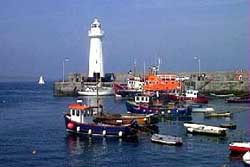
Donaghadee is a growing town on the northern coast of County Down, six miles from the historic town of Bangor and approximately 20 miles east of Belfast. It lies on the northeast coast of the Ards PeninsulaWith a population of about 8,000 inhabitants, Donaghadee is the closest point to Scotland, so close in fact, that the Scottish coast is visible to the naked eye on clear days. The town offers a rich history, having been one of the main ports of entry to the island of Ireland until the 19th Century. It is probably best known for its lighthouse and harbour, which has been a haven for ships for centuries. The harbour has been there since at least the 17th century. Aside from the historical buildings reflecting its rich heritage, the town has a picturesque seafront and a wide range of cafes and restaurants. Among these is Grace Neill's, which opened in 1611 as the 'King's Arms' and claims to be the oldest pub on the island of Ireland, a record officially held by Sean's Bar in the Republic of Ireland.

The other reason Donaghadee may be famous is because of the Donaghadee Male Voice Choir. It was founded in 1932 and began as a small local chorus performing in churches and other local functions. Since then, the Choir has developed and flourished and today is an internationally known Choir having performed on stage, radio and television in the USA and Canada, among other international locations. With a membership of around 70 and a repertoire which embraces both secular and sacred music and ranges from folk and traditional songs to choral favorites and operativ works, it is something not to be missed while visiting Ireland. 

Wednesday, December 12, 2012

Belfast - capital of Northern Ireland

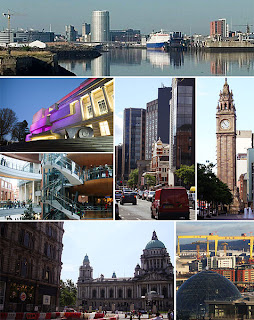
Belfast (from Irish: Béal Feirste, meaning "mouth of the shoal") is the capital of and largest city in Northern Ireland. By population, it is the fourteenth largest city in the United Kingdom and second largest on the island of Ireland. It is the seat of the devolved government and legislative Northern Ireland Assembly.  Belfast was granted city status in 1888. Historically, Belfast has been a centre for the Irish linen industry (earning the nickname "Linenopolis"), tobacco production, rope-making and shipbuilding: the city's main shipbuilders, Harland and Wolff, which built the well-known RMS Titanic, propelled Belfast on to the global stage in the early 20th century as the biggest and most productive shipyard in the world. Belfast played a key role in the Industrial Revolution, establishing its place as a global industrial center until the latter half of the 20th century. Industrialization and the inward migration it brought made Belfast, if briefly, the biggest city in Ireland at the turn of the 20th century and the city's industrial and economic success was cited by Ulster unionist opponents of Home Rule as a reason why Ireland should shun devolution and later why Ulster in particular would fight to resist it. Today, Belfast remains a center for industry, as well as the arts, higher education and business, a legal center, and is the economic engine of Northern Ireland. The city suffered greatly during the period of conflict called the Troubles, but latterly has undergone a sustained period of calm, free from the intense political violence of former years, and substantial economic and commercial growth. Belfast city center has undergone considerable expansion and regeneration in recent years, notably around Victoria Square. Belfast is also a major seaport, with commercial and industrial docks dominating the Belfast Lough shoreline, including the famous Harland and Wolff shipyard. Belfast is a constituent city of the Dublin-Belfast corridor, which has a population of three million, or half the total population of the island of Ireland.

Wednesday, December 5, 2012

Waterford - Ireland's oldest tourist destination, founded by the vikings in 914AD.

Waterford is the oldest city in Ireland. A walled city of Viking origins, it retains much of it's medieval character together with the graceful buildings from its 18th century expansion.
Waterford is the home of Waterford Crystal, the world-famous hand-crafted, cut glass product. The Waterford Crystal Visitor Center is home to the largest collection of Waterford Crystal in the world and the guided tours offer access to all areas of traditional crystal production. Waterford Museum of Treasures comprises three magnificent museums chronicling over one thousand years of history. It is both a treasury of gold, bronze, silver, crystal and historical documents and a treasure trail that takes you through 1000 years of Ireland's oldest city. The Treasures of Viking Waterford in Reginald's Tower - the Chorister's Hall will open in 2012 and house the Medieval Treasures, and the recently renovated Georgian Bishop's Palace tells the story from 1700 to 1970.
The parameters of the 10th century settlement can be clearly identified in The Viking Triangle. Reginald's Tower is the oldest civic urban building in Ireland. The elegant Chamber of Commerce building, Christ Church Cathedral, the City Hall and the Bishop's Palace are prime examples of beautiful 18th century architecture.
Ecclesiastical landmarks include St. Patrick's Churches, Black Friars, St. Olave's Church and Greyfriars - .
The Church Of Ireland Christ Church Cathedral, and the Catholic Cathedral of the Most Holy Trinity were both designed by Waterford architect John Roberts (1714 - 1796).
The Edmund Rice International Heritage Center commemorates the founder of the Christian Brothers, Edmund Ignatius Rice.
The Granville Hotel was the home of the 18th century patriot, Thomas Francis Meagher before passing to the great transport entrepreneur, Carlo Bianconi.

Friday, November 16, 2012

Confirmed Venue: Theatre Royal, Waterford

The Greeley Chorale travelers will have the opportunity to perform in the Theatre Royal in Waterford on Sunday, June 2nd 2013. 
Located in Waterford city's historic quarter, the Theatre Royal is one of Waterford's longest running arts and entertainment venue. It is part of a row of iconic buildings such as the Bishops Palace, Christ Church Cathedral and the City Hall building. Together, they form an architecturally impressive and historic quarter.
 
The history of the Theatre Royal dates back 220 years to its beginnings in 1810. However, even before that a Playhouse and Assembly Rooms were established in the 1700's due to the rise in prosperity in the city. It was here that the first performances were held. From 1779 on, the development of the theatre can be traced alongside historic events both at home and abroad. Then, in the early 1800's, the Playhouse was upgraded in the west wing of the City Hall building. The 20th century brought the introduction of cinematograph performances.
Photos courtesy of Theatre Royal website.

Wednesday, November 7, 2012

Confirmed venue: Ulster Hall, Belfast

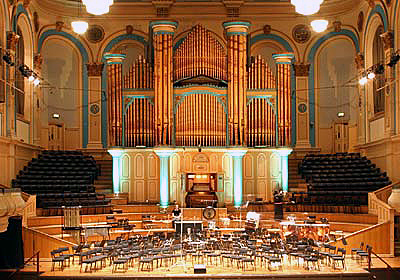
On Saturday, June 1st 2013, the Greeley Chorale will perform a joint concert with the Donaghadee Male Voice Choir in Ulster Hall, Belfast. 

Ulster Hall was built in 1859 and opened in 1862. It was openend to provide the expanding city of Belfast with a larger multi-purpose venue. Even though larger concert halls have been opened in the city since then, Ulster Hall has remained a popular venue.
Belfast Corporation bought the building in 1902 and the Hall has been host to famous figures from the beginning: from Jenny Lind and Caruso to Charles Dickens and John McCormack, from Lord Carson and the Dalai Lama to Barry McGuigan and the Rolling Stones.
During World War II, the Ulster Hall was used extensively as a dance hall in order to provide entertainment for the American troops stationed in Northern Ireland. A shipment of American white oak planking later mysteriously arrived in Belfast to refurbish the dance floor.  
Moreover, the Mulholland Grand Organ in the Ulster Hall is one of the oldest examples of a functioning classic English pipe organ. 

Tuesday, October 30, 2012

Helpful Tips: Map of Ireland

 
Dear Greeley Chorale travelers, 
In preparation for your upcoming journey to Ireland, here a few links to helpful information:

The Official Tourism Ireland Website

Maps and Brochures of Ireland

Explore Ireland through videos


Monday, October 22, 2012

Discover Belfast with Incantato Tours

Even though Northern Ireland's capital is a smaller city of around 300,000 inhabitants, it has a unique history and a rich culture. Trace Belfast's 300-year history back to its humble origins and explore the original 1660s street layout or remarkable examples of Victorian architecture found in buildings such as the City Hall or Albert Clock Memorial. 
Some other notable events throughout the city's long history include:


  • The invention of air conditioning by Belfast's Sirocco Works in the scope of which the Royal Victorian Hospital became the first building in the world to be fitted with AC.
  • Belfast-educated Sir Hans Sloane, who was responsible for first creating milk chocolate. 
  • William Drennan, who first coined the expression 'Emerald Isle' in 1796.
  • The discovery of carbon dioxide by Joseph Black, son of a Belfast wine merchant, whose principles were used by James Watt to develop the steam engine. 

Once home to the Irish linen industry, tobacco production, and rope making, Belfast also became the site of ship building after locals developed a boat building trade at the mouth of the Lagan river. It is no surprise, then, that one of Belfast's most famous affiliations is to the Titanic, the concept for which was developed in Belfast in the early 1900s. Now the world's largest visitor experience, the Titanic Museum is located next to the historic site of the Titanic's construction and tells the story from her conception, through her construction and launch, to her famous maiden voyage and tragic end.


Thursday, October 11, 2012

The Gathering 2013 - Discover Ireland with Incantato Tours

If you want to find out the inspiration behind U2, James Joyce and Riverdance, and connect with the Land of Saints and Scholars, you are invited to join The Gathering. An unprecedented event for the Irish and the Irish at heart, The Gathering 2013 is a yearlong celebration of the wonders of Ireland in a long lineup of festivities, bringing Ireland's culture, music, arts, sports, and heritage fully to life. Whether you are Irish in ancestry or in spirit or have a curiosity about Ireland's history and people, 2103 is a great time to be visiting the Emerald Isle. Everyone is invited to experience the home of so many stories and songs as the people of Ireland will be the focus of the events in their communities, towns, and villages. Enjoy traditional Irish food, kiss the the Blarney stone, have a go at hurling, sample Atlantic seafood in Galway, or feel the wind ruffle your hair on the Cliffs of Moher. 
With over 70 million people worldwide claiming Irish ancestry, The Gathering provides an opportunity to visit Ireland and reconnect as communities throughout the country showcase and share their Irish culture and  traditions. The event begins on New Year's Eve in Dublin. Afterward, The Gathering is meant to be a people-led project as everyone is encouraged to create local gatherings of their own, inviting friends from around the world to come and see what The Gathering is all about. 

Tuesday, October 2, 2012

Northern Ireland: the Giant's Causeway

In 1986, UNESCO named Ireland's first World Heritage Site: the Giant's Causeway, a mysterious geological formation on the North-Eastern coast of Ireland. 
The site is an area of approximately 40,000 interlocking, hexagonal basalt columns that are neatly packed together and form a jagged headland which points towards Scotland. 
Visitors can walk along the columns as they form stepping stones that disappear downward into the sea. 
Science, myth and legend surround the Giant's Causway, the latter of which is the most colorful. It is said that the Causeway was the stomping ground of a giant who lived in the area two thousand years ago. Perhaps you may discover the chimney to one of his houses or the boot he left lying by the beach?
In the newly opened Visitor's Center you learn that, according to geologists, the site is believed to have been formed some 50-60 million years ago and is the result of an ancient volcanic eruption.
Often described as the Eighth Wonder of the World, the Giant's Causeway was documented as early as 1693 and realistic sketches of the site were published in 1740. 
Not far from the Giant's Causeway, you will also find the Carrick-a-rede Rope Bridge. Traditionally the bridge was erected by fishermen over a 75-foot deep and 66-foot wide chasm in order to check their salmon nets. 
Anyone brave enough to cross is sure to be rewarded with a fantastic view. 

Friday, September 14, 2012

Aran Islands - an Incantato Favorite

The Aran Islands lie just outside Galway Bay and not far from the Cliffs of Moher on the west coast of Ireland. The three islands, Inis Mor Island (Big Island), Inis Meain Island (Middle Island), and Inis Oirr Island (East Island) are famous for their geological formations, historical monuments and their linguistic and cultural heritage. 
Inis Mor is the largest of the three, comprising about 7,600 acres. Here, you can find several ancient stone forts and churches, one of the most impressive of which is Dun Aengus. This semicircular fort rests on the edge of a cliff and consists of an inner court surrounded by a wall 20 feet high and 16 feet thick at the base. 
There are about 1,100 inhabitants on Inis Mor, making it by far the most populated of the three islands. The main village and also main harbor is Kilronan. 
The middle island, Inis Meain, is said to be the most untouched of the islands. Here you can experience the natural, cultural and traditional way of life of the islanders. Inis Meain has about 200 inhabitants, 300 flowering plants, as well as a wide variety of nesting birds. Here, too, you will find ancient stone forts, one of the oldest of which is Dun Fearbha from the 4th century AD. It is an unusual structure as it is more square than circular like the rest of the forts on the islands. 
Inis Oirr, the east island, is also the smallest of the three with only 1,400 acres and 300 inhabitants. There is a large three-story castle dating back to around 1585, as well as several ruins of churches to be discovered here.